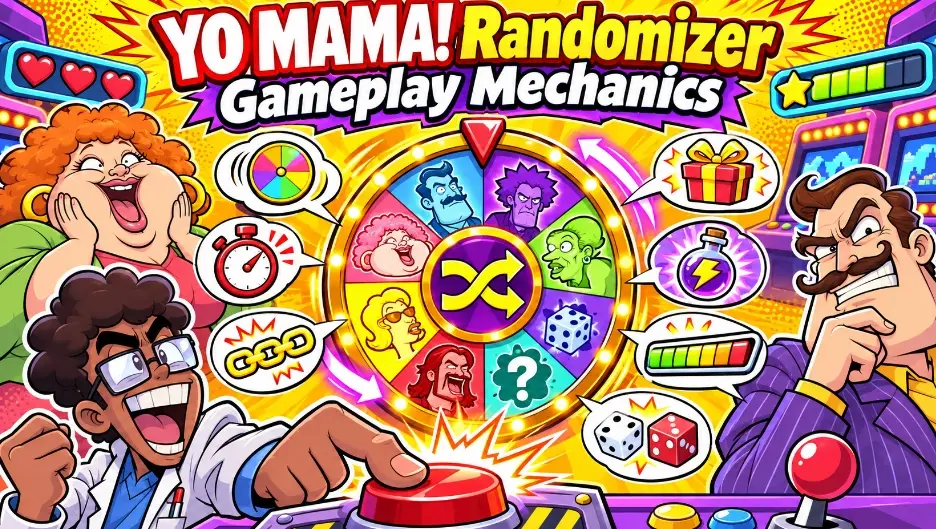
YO MAMA! Randomizer Gameplay Mechanics
The gameplay mechanics of YO MAMA! Randomizer are based on generating new video sequences from previously produced animated comedy material. Unlike games that use movement, combat, resource collection, or character development, the generator relies on randomized selection and media combination.
Its central mechanic transforms material with a predefined meaning into sequences that may have entirely different interpretations. The resulting experience is determined by the relationship between the selected fragments rather than by the player’s ability to perform complicated actions.
Core Mechanics
The generator’s basic interaction consists of requesting a result, processing the available material, and presenting a video combination.
| Mechanic | Function |
|---|---|
| Random Selection | Determines which material is included |
| Video Combination | Connects selected fragments |
| Joke Presentation | Displays the resulting sequence |
| Regeneration | Allows another combination to be requested |
| Repetition | Permits familiar material to appear again |
| Interpretation | Allows users to evaluate the resulting joke |
These mechanics describe the observable behavior of the generator rather than its undocumented internal software architecture.
Source Material System
YO MAMA! Randomizer relies on animated joke footage rather than a conventional collection of playable environments. The source material includes spoken dialogue, character animation, visual reactions, and references originally produced for the YO MAMA! series.
Original comedy videos usually present these elements in a deliberate order. The setup establishes a subject, and the punchline provides the intended conclusion.
Randomization changes this relationship by using material outside its original context.
The concepts involved include:
- Previously recorded voiceovers.
- Animated character appearances.
- Joke introductions.
- Situational descriptions.
- Punchlines.
- Visual reactions.
- References to existing entertainment media.
Depending on how fragments are selected and arranged, a resulting sequence may preserve or interrupt the original structure.
Joke Structure
A typical Yo Mama joke can be analyzed using three principal components: a premise, a setup, and a punchline.
The premise describes an exaggerated personal characteristic. The setup introduces an event, object, or comparison connected to that characteristic. The punchline completes the statement by providing an unexpected explanation or consequence.
| Component | Role in the Original Joke | Effect of Randomization |
|---|---|---|
| Premise | Establishes the subject | Introduces a potentially unrelated category |
| Setup | Creates the situation | Changes the context of the joke |
| Punchline | Delivers the conclusion | Produces an unexpected ending |
| Animation | Illustrates the described event | May contradict the spoken dialogue |
| Voiceover | Connects the joke’s elements | Maintains recognizable narration |
This breakdown is a way of analyzing joke construction. It does not establish that every generated video uses exactly three independently selected clips.
Combination Mechanics
The central purpose of the randomizer is to create combinations that differ from the original joke sequences. A selected introduction might be followed by a situation from another episode, while the ending may introduce a completely different subject.
For example, a hypothetical combination could begin with an age-related premise, continue with a situation involving a supermarket, and finish with a reference to a video game.
The individual elements would remain recognizable, but their combined meaning would change.
Different combinations can produce:
- Logical relationships between fragments.
- Unexpected changes of subject.
- Inconsistent character appearances.
- Contradictory spoken descriptions.
- Unrelated visual reactions.
- Repeated phrases in new contexts.
The humor often depends on how sharply the final sequence differs from the expectations established at its beginning.
Randomness and Probability
Random selection does not guarantee that every generated result will be completely different. Depending on the selection system, individual fragments can appear repeatedly.
A simplified mathematical model demonstrates how the number of possible combinations can increase when multiple groups of fragments are available.
Suppose a hypothetical generator contains ten introductions, twenty setups, and thirty punchlines. If every combination is permitted, the number of possible arrangements would be 6,000.
| Introductions | Setups | Punchlines | Possible Combinations |
|---|---|---|---|
| 5 | 10 | 10 | 500 |
| 10 | 20 | 30 | 6,000 |
| 20 | 30 | 50 | 30,000 |
| 100 | 100 | 100 | 1,000,000 |
These figures are illustrative examples. They are not confirmed statistics for YO MAMA! Randomizer.
The real number of available combinations depends on the source library, permitted arrangements, and any limitations imposed by the generator.
Coherent and Incoherent Results
A coherent result occurs when the selected fragments form an understandable statement or situation. An incoherent result occurs when the components do not establish a clear relationship.
Neither type necessarily represents a successful or unsuccessful generation. Both are compatible with the concept of randomized comedy.
Users may personally prefer particular outcomes and attempt to discover them through repeated generations.
Rare Combinations
The community may describe unusual results as rare combinations. This term generally refers to videos that participants believe they encounter infrequently or find particularly unexpected.
However, the actual probability of a specific combination cannot be determined without information about the underlying selection rules.
There is no verified rarity classification establishing categories such as Common, Rare, Epic, or Legendary for generated jokes.
These labels can be used informally in community challenges, but they should not be presented as official gameplay mechanics.
Progression and Replay System
YO MAMA! Randomizer does not use experience points, character upgrades, numbered stages, or a conventional completion system.
Each generation functions as a separate interaction. The player observes the current result and decides whether to generate another.
The replay system depends on the possibility of encountering different relationships between existing fragments. Even a familiar introduction can have a different meaning when paired with another ending.
The generator therefore uses content variation rather than difficulty progression to provide replayability.
